# react-intl-universal
**Repository Path**: alibaba/react-intl-universal
## Basic Information
- **Project Name**: react-intl-universal
- **Description**: Internationalize React apps. Not only for Component but also for Vanilla JS.
- **Primary Language**: Unknown
- **License**: Not specified
- **Default Branch**: master
- **Homepage**: None
- **GVP Project**: No
## Statistics
- **Stars**: 0
- **Forks**: 0
- **Created**: 2024-10-31
- **Last Updated**: 2026-07-15
## Categories & Tags
**Categories**: Uncategorized
**Tags**: None
## README
# react-intl-universal
[react-intl-universal](https://github.com/alibaba/react-intl-universal) is a React internationalization package developed by [Alibaba Group](http://www.alibabagroup.com).
[](https://npm-compare.com/react-intl-universal) [](https://www.npmjs.com/package/react-intl-universal) [](https://github.com/alibaba/react-intl-universal/blob/master/LICENSE.md)
## ✨ Features
- Can be used not only in React component but also in Vanilla JS.
- Simple API surface centered around `intl.get`.
- Display locale-aware numbers.
- Stable date/time helpers: `formatDate`, `formatTime`, and `formatDateTime` return deterministic `YYYY-MM-DD`, `HH:mm:ss`, and `YYYY-MM-DD HH:mm:ss`. This avoids native `Intl` output drift across runtimes, which has caused SSR and CI issues in [tc39/ecma402#1028](https://github.com/tc39/ecma402/issues/1028), [nodejs/node#44454](https://github.com/nodejs/node/issues/44454), [nodejs/node#46123](https://github.com/nodejs/node/issues/46123), and [formatjs/formatjs#1319](https://github.com/formatjs/formatjs/issues/1319).
- Pluralize labels in strings.
- Support variables in message.
- Support [React rich text component interpolation in message](https://alibaba.github.io/react-intl-universal#intl-usage).
- Support for 150+ languages.
- Runs in the browser and Node.js.
- Message format is strictly implemented by [ICU standards](http://userguide.icu-project.org/formatparse/messages).
- Locale data in nested JSON format are supported.
- [react-intl-universal-extract](https://alibaba.github.io/react-intl-universal/#extract-usage) helps you generate a locale file easily.
- [use-react-intl-universal skill](https://alibaba.github.io/react-intl-universal/#skill-usage) helps AI coding agents produce natural translations, stable localized UI, and reviewable locale updates.
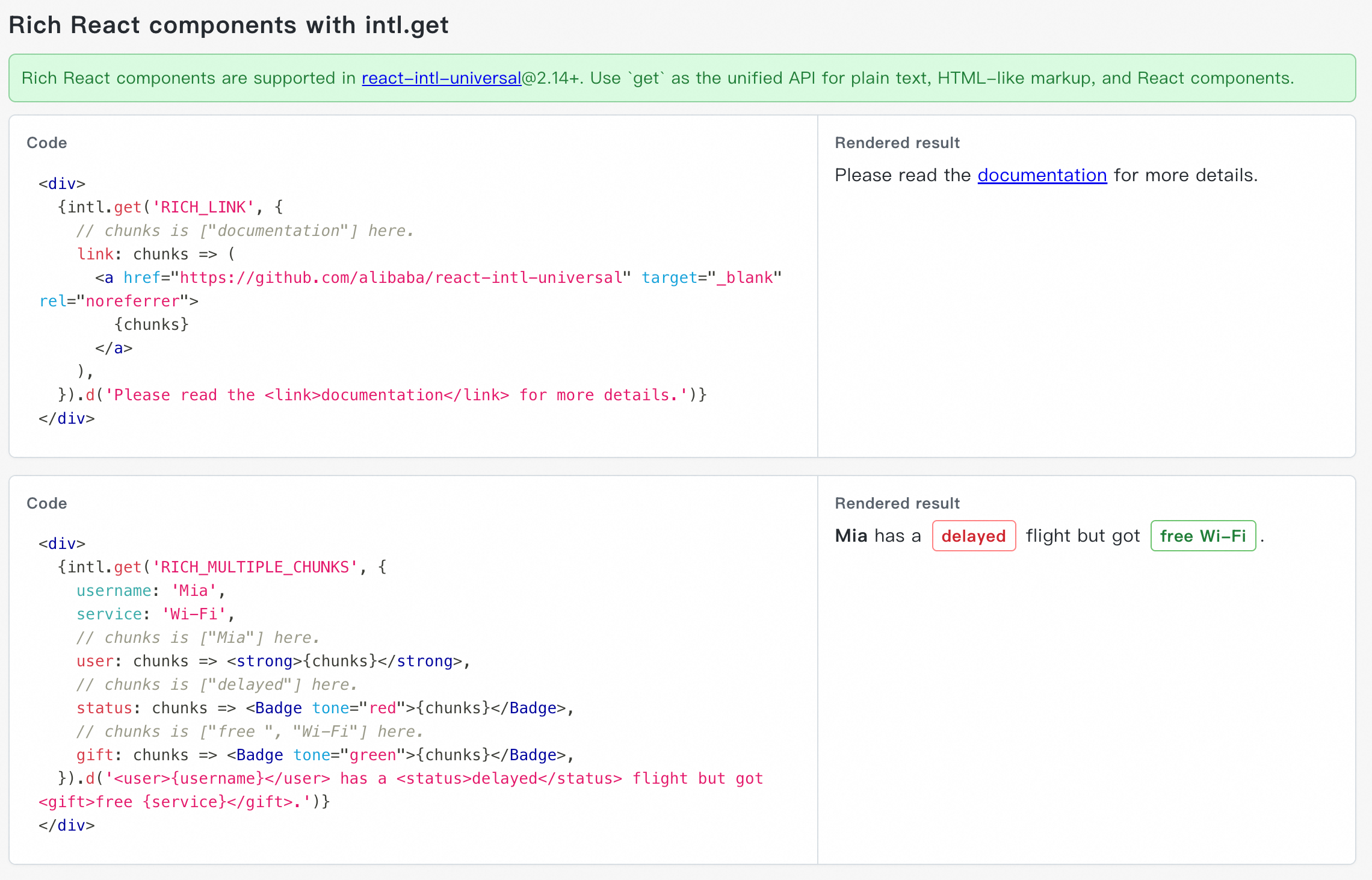
## ⚡ New in react-intl-universal@2.14+: Support Rich React Components with `intl.get`
Upgrade to react-intl-universal@2.14+ to use `intl.get(...)` as the recommended unified API for plain text, ICU variables, and rich React components.
See the [live demo](https://alibaba.github.io/react-intl-universal/#intl-usage) for runnable examples. You can keep one complete sentence in the locale message, while React code controls the actual component, props, and event handlers:
## ⚡ New: Let AI Agents Ship Better Internationalized UI
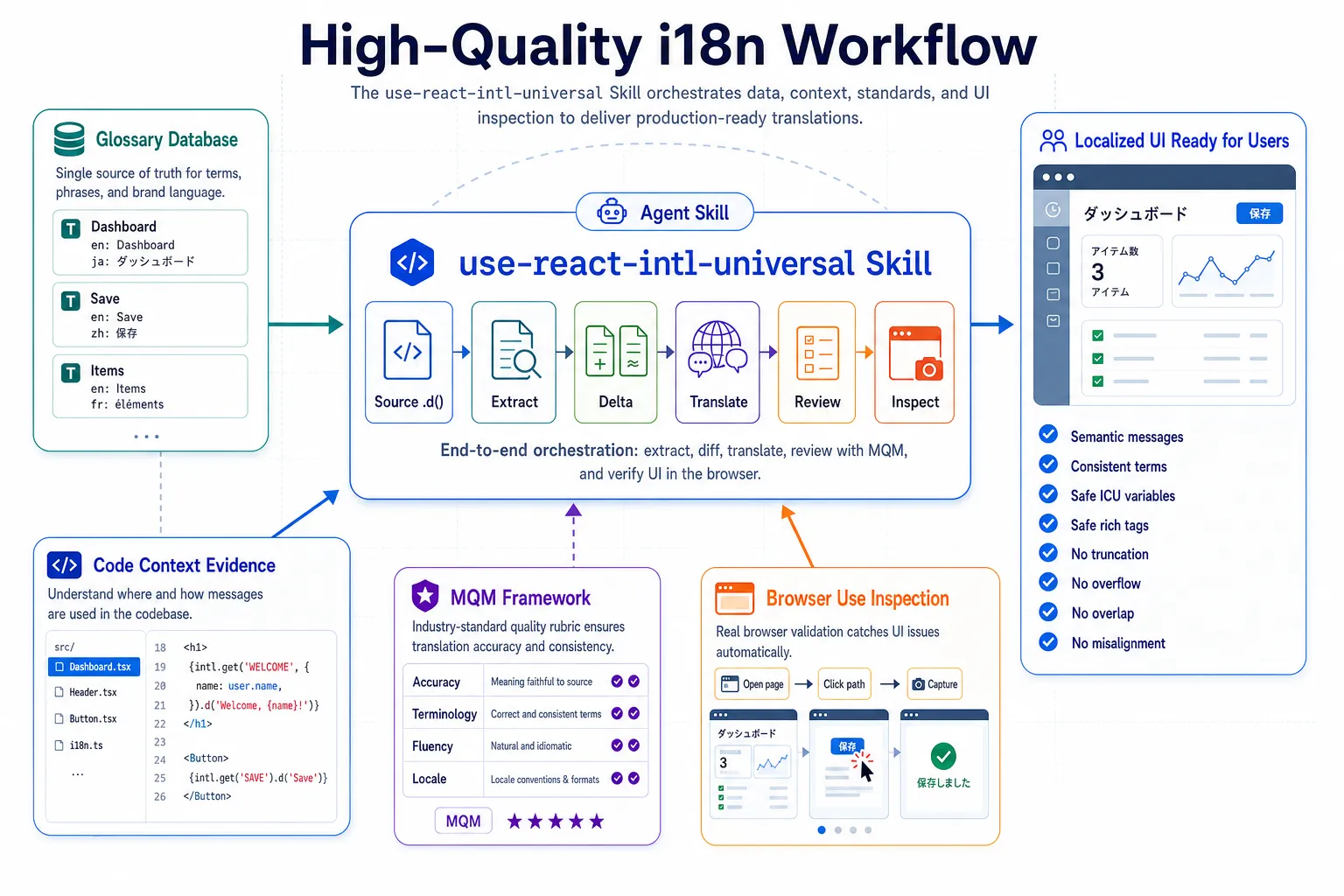
Use the [use-react-intl-universal skill](https://alibaba.github.io/react-intl-universal/#skill-usage) to give AI coding agents a practical i18n workflow, not just API hints.
It helps agents:
- write high-quality localized copy that preserves the real product meaning, not word-for-word translations;
- keep product terms and UI wording consistent across modules;
- avoid broken localized UI, such as text truncation, overflow, overlap, or misalignment;
- keep ICU variables, rich tags, default messages, and locale files aligned;
- review translation quality with [Multidimensional Quality Metrics (MQM)](https://www.w3.org/community/mqmcg), one of the most professional and comprehensive translation quality assessment frameworks widely recognized in the localization industry;
- inspect running localized pages by URL, click through interactions, capture screenshots, and generate a process-and-findings report;
- produce smaller, more reviewable locale changes.
## 💡 Why Another Internationalization Solution for React?
In case of internationalizing React apps, [react-intl](https://github.com/yahoo/react-intl) is one of most popular package in industry. [react-intl](https://github.com/yahoo/react-intl) decorate your React.Component with wrapped component which is injected internationalized message dynamically so that the locale data is able to be loaded dynamically without reloading page. The following is the example code using [react-intl](https://github.com/yahoo/react-intl).
```js
import { injectIntl } from 'react-intl';
class MyComponent extends Component {
render() {
const intl = this.props;
const title = intl.formatMessage({ id: 'title' });
return (
{title}
);
}
};
export default injectIntl(MyComponent);
```
However, this approach introduces two major issues.
Firstly, Internationalizing can be applied only in view layer such as React.Component. For Vanilla JS file, there's no way to internationalize it. For example, the following snippet is general form validator used by many React.Component in our apps. We definitely will not have such code separated in different React.Component in order to internationalize the warning message. Sadly, [react-intl](https://github.com/yahoo/react-intl) can't be used in Vanilla JS.
```js
export default const rules = {
noSpace(value) {
if (value.includes(' ')) {
return 'Space is not allowed.';
}
}
};
```
Secondly, since your React.Component is wrapped by another class, the behavior is not as expected in many way. For example, to get the instance of React.Component, you can't use the normal way like:
```js
class App {
render() {
}
getMyInstance() {
console.log('getMyInstance', this.refs.my);
}
}
```
Instead, you need to use the method ```getWrappedInstance()``` to get that.
```js
class MyComponent {...}
export default injectIntl(MyComponent, {withRef: true});
class App {
render() {
}
getMyInstance() {
console.log('getMyInstance', this.refs.my.getWrappedInstance());
}
}
```
Furthermore, your React.Component's properties are not inherited in subclass since component is injected by [react-intl](https://github.com/yahoo/react-intl).
Due to the problem above, we create [react-intl-universal](https://www.npmjs.com/package/react-intl-universal) to internationalize React app using simple but powerful API.
## 📚 APIs Definition
```js
/**
* Initialize properties and load locale data according to currentLocale
* @param {Object} options
* @param {string} options.escapeHtml To escape html. Default value is true.
* @param {string} options.currentLocale Current locale such as 'en-US'
* @param {Object} options.locales App locale data like {"en-US":{"key1":"value1"},"zh-CN":{"key1":"值1"}}
* @param {Object} options.warningHandler Ability to accumulate missing messages using third party services. See https://github.com/alibaba/react-intl-universal/releases/tag/1.11.1
* @param {string} options.fallbackLocale Fallback locale such as 'zh-CN' to use if a key is not found in the current locale
* @param {boolean} options.debug If debugger mode is on, the message will be wrapped by a span with data key
* @param {string} options.dataKey If debugger mode is on, the message will be wrapped by a span with this data key. Default value 'data-i18n-key'
* @returns {Promise}
*/
init(options)
/**
* Load more locales after init
* @param {Object} locales App locale data
*/
load(locales)
/**
* Get the formatted message by key.
* Returns string for plain messages.
* Returns React-renderable chunks array when variables contain rich tag formatter functions
* and every parsed rich tag has a matching formatter.
* @param {string} key The string representing key in locale data file
* @param {Object} variables Variables in message
* @returns {string|React.ReactNode[]} message
*/
get(key, variables)
/**
* Legacy API: get the formatted html message by key.
* Prefer get(key, variables) with rich tag formatter functions for new React code.
* @param {string} key The string representing key in locale data file
* @param {Object} variables Variables in message
* @returns {React.Element} message
*/
getHTML(key, options)
/**
* Helper: determine user's locale via URL, cookie, and browser's language.
* You may not need this API, if you have other rules to determine user's locale.
* @param {string} options.urlLocaleKey URL's query Key to determine locale. Example: if URL=http://localhost?lang=en-US, then set it 'lang'
* @param {string} options.cookieLocaleKey Cookie's Key to determine locale. Example: if cookie=lang:en-US, then set it 'lang'
* @param {string} options.localStorageLocaleKey LocalStorage's Key to determine locale such as 'lang'
* @returns {string} determined locale such as 'en-US'
*/
determineLocale(options)
/**
* Change current locale
* @param {string} newLocale Current locale such as 'en-US'
*/
changeCurrentLocale(newLocale)
/**
* Get the inital options
* @returns {Object} options includes currentLocale and locales
*/
getInitOptions()
/**
* Formats a list of React nodes for proper internationalized formatting.
* @param {React.ReactNode[]} nodeList - Array of React nodes to format.
* @param {Intl.ListFormatOptions} options - Intl.ListFormat options.
* @returns {React.ReactNode[]} Array of React nodes formatted with locale-appropriate separators.
*
* @example
* For en-US locale: formatList(["str1", "str2"]) => Returns: ["str1", ", ", "str2"] => Render as: "str1, str2" in React.js
* For zh-CN locale: formatList(["str1", "str2"]) => Returns: ["str1", "、", "str2"] => Render as: "str1、str2" in React.js
*/
formatList(nodeList, options)
/**
* Returns locale-specific parentheses format for the current language.
* @param {React.ReactNode} node - The content to be wrapped in parentheses.
* @returns {ReactNode[]} An array containing left parenthesis, content, and right parenthesis.
*
* @example
* For en-US locale: formatParentheses("str1") => Returns ["(", "str1", ")"] => Render as "(str1)" in React.js
* For zh-CN locale: formatParentheses("str1") => Returns ["(", "str1", ")"] => Render as "(str1)" in React.js
*/
formatParentheses(node)
/**
* Returns locale-specific colon character for the current language.
* @returns {string} The locale-appropriate colon character.
*
* @example
* For en-US locale: <>{intl.get("LABEL_NAME")}{intl.getColon()}{intl.get("VALUE")} => Returns "label: value"
* For zh-CN locale: <>{intl.get("LABEL_NAME")}{intl.getColon()}{intl.get("VALUE")} => Returns "label:value"
*/
getColon()
/**
* Formats a Date or timestamp as a stable ISO 8601 date: YYYY-MM-DD.
* @param {Date|number} value - The Date or timestamp to format.
* @returns {string} The formatted date.
*
* @example
* formatDate(new Date(2026, 0, 2)) => Returns "2026-01-02"
*/
formatDate(value)
/**
* Formats a Date or timestamp as stable 24-hour time with seconds: HH:mm:ss.
* @param {Date|number} value - The Date or timestamp to format.
* @returns {string} The formatted time.
*
* @example
* formatTime(new Date(2026, 0, 2, 15, 30, 45)) => Returns "15:30:45"
*/
formatTime(value)
/**
* Formats a Date or timestamp as stable ISO 8601 date plus 24-hour time: YYYY-MM-DD HH:mm:ss.
* @param {Date|number} value - The Date or timestamp to format.
* @returns {string} The formatted date and time.
*
* @example
* formatDateTime(new Date(2026, 0, 2, 15, 30, 45)) => Returns "2026-01-02 15:30:45"
*/
formatDateTime(value)
/**
* Formats a number according to the current locale.
* @param {number} number - The number to format.
* @returns {string} The formatted number.
*
* @example
* For en-US locale: formatNumber(1234.56) => Returns "1,234.56"
* For de-DE locale: formatNumber(1234.56) => Returns "1.234,567"
* For fr-FR locale: formatNumber(1234.56) => Returns "1 234,567"
*/
formatNumber(number)
```
## 🔄 Compatibility with react-intl
As mentioned in the issue [Mirror react-intl API](https://github.com/alibaba/react-intl-universal/issues/2), to make people switch their existing React projects from [react-intl](https://github.com/yahoo/react-intl) to [react-intl-universal](https://www.npmjs.com/package/react-intl-universal). We provide two compatible APIs as following.
```js
/**
* As same as get(...) API
* @param {Object} options
* @param {string} options.id
* @param {string} options.defaultMessage
* @param {Object} variables Variables in message
* @returns {string|React.ReactNode[]} message
*/
formatMessage(options, variables)
```
```js
/**
* Legacy API: as same as getHTML(...) API
* @param {Object} options
* @param {string} options.id
* @param {React.Element} options.defaultMessage
* @param {Object} variables Variables in message
* @returns {React.Element} message
*/
formatHTMLMessage(options, variables)
```
For example, the `formatMessage` API
```js
const name = 'Tony';
intl.formatMessage({ id:'hello', defaultMessage: 'Hello, {name}'}, {name});
```
is equivalent to `get` API
```js
const name = 'Tony';
intl.get('hello', {name}).d('Hello, {name}');
```
And the legacy `formatHTMLMessage` API
```js
const name = 'Tony';
intl.formatHTMLMessage({ id:'hello', defaultMessage:
Hello
}, {name});
```
is equivalent to `getHTML` API
```js
const name = 'Tony';
intl.getHTML('hello', {name}).d(
Hello
);
```
## ❓ FAQ
### 1. How Do I Determine the User's Locale?
[react-intl-universal](https://www.npmjs.com/package/react-intl-universal) provides a helper to determine the user's `currentLocale`. In the running examples, when a user selects a new locale, the page is redirected to a URL like `http://localhost:3000?lang=en-US`. Then you can use `intl.determineLocale` to read the locale from the URL.
It can also determine the user's locale from cookies, localStorage, or the browser's default language. Refer to the APIs section for more detail.
### 2. How Do I Internationalize a Reusable React Component?
When internationalizing a React component, you don't need to call `intl.init` again.
You can make `react-intl-universal` a [peerDependency](https://github.com/alibaba/react-intl-universal/blob/master/packages/react-intl-universal/examples/component-example/package.json#L34), then just [load](https://github.com/alibaba/react-intl-universal/tree/master/packages/react-intl-universal/examples/component-example/src/index.tsx#L16) the locale data in the component.
### 3. How Do I Enable Debugger Mode?
When developing a website with multiple languages (i18n), translators are usually responsible for translating the content instead of the web developer. However, translators often struggle to find the specific message they need to edit on the webpage because they don't know its key. This leads to them having to ask the developer for the key, resulting in a lot of time wasted on communication.
To solve this issue, enable debugger mode in `react-intl-universal`. Each message on the webpage will be wrapped in a special span element with the key `data-i18n-key`. This way, translators can easily see the key of the message and make the necessary edits themselves using some message management system, without needing to ask the developer.
Enabling debugger mode:
```js
intl.init({
// ...
debug: true
})
```
Message will be wrapped in a span element with the key `data-i18n-key`:

### 4. How to Internationalize Message in Constants Object?
If constants are defined outside of a React component, the message in `constants.fruits` may get loaded before `intl.init(...)`. This can cause a warning to be displayed, such as `react-intl-universal locales data "null" not exists`.
```jsx
// Wrong: the message in constants.fruits is loaded before `intl.init(...)`
const constants = {
fruits : [
{ label: intl.get('banana'), value: 'banana' },
{ label: intl.get('apple'), value: 'apple' },
]
}
function MyComponent() {
return
}
```
To fix this, you should call `intl.init` before `render`.
#### Solution 1
Make the message object as a function, and call it at render function.
```jsx
const constants = {
fruits : () => [ // as arrow function
{ label: intl.get('banana'), value: 'banana' },
{ label: intl.get('apple'), value: 'apple' },
]
}
function MyComponent() {
// fruits is a function which returns message when rendering
return
}
```
#### Solution 2
Use [getter](https://developer.mozilla.org/en-US/docs/Web/JavaScript/Reference/Functions/get) syntax to make a function call when that property is looked up
```jsx
const constants = {
fruits: [
{
get label() {
return intl.get("banana");
},
value: "banana",
},
{
get label() {
return intl.get("apple");
},
value: "apple",
},
],
};
function MyComponent() {
// When "label" property is looked up, it actually make a function call
return ;
}
```
## 📈 Usage Trend
[Usage Trend of react-intl-universal](https://npm-compare.com/react-intl-universal)
## 📄 License
This software is free to use under the BSD license.
 It helps agents:
- write high-quality localized copy that preserves the real product meaning, not word-for-word translations;
- keep product terms and UI wording consistent across modules;
- avoid broken localized UI, such as text truncation, overflow, overlap, or misalignment;
- keep ICU variables, rich tags, default messages, and locale files aligned;
- review translation quality with [Multidimensional Quality Metrics (MQM)](https://www.w3.org/community/mqmcg), one of the most professional and comprehensive translation quality assessment frameworks widely recognized in the localization industry;
- inspect running localized pages by URL, click through interactions, capture screenshots, and generate a process-and-findings report;
- produce smaller, more reviewable locale changes.
## 💡 Why Another Internationalization Solution for React?
In case of internationalizing React apps, [react-intl](https://github.com/yahoo/react-intl) is one of most popular package in industry. [react-intl](https://github.com/yahoo/react-intl) decorate your React.Component with wrapped component which is injected internationalized message dynamically so that the locale data is able to be loaded dynamically without reloading page. The following is the example code using [react-intl](https://github.com/yahoo/react-intl).
```js
import { injectIntl } from 'react-intl';
class MyComponent extends Component {
render() {
const intl = this.props;
const title = intl.formatMessage({ id: 'title' });
return (
It helps agents:
- write high-quality localized copy that preserves the real product meaning, not word-for-word translations;
- keep product terms and UI wording consistent across modules;
- avoid broken localized UI, such as text truncation, overflow, overlap, or misalignment;
- keep ICU variables, rich tags, default messages, and locale files aligned;
- review translation quality with [Multidimensional Quality Metrics (MQM)](https://www.w3.org/community/mqmcg), one of the most professional and comprehensive translation quality assessment frameworks widely recognized in the localization industry;
- inspect running localized pages by URL, click through interactions, capture screenshots, and generate a process-and-findings report;
- produce smaller, more reviewable locale changes.
## 💡 Why Another Internationalization Solution for React?
In case of internationalizing React apps, [react-intl](https://github.com/yahoo/react-intl) is one of most popular package in industry. [react-intl](https://github.com/yahoo/react-intl) decorate your React.Component with wrapped component which is injected internationalized message dynamically so that the locale data is able to be loaded dynamically without reloading page. The following is the example code using [react-intl](https://github.com/yahoo/react-intl).
```js
import { injectIntl } from 'react-intl';
class MyComponent extends Component {
render() {
const intl = this.props;
const title = intl.formatMessage({ id: 'title' });
return (