# fmt
**Repository Path**: mirrors_trending/fmt
## Basic Information
- **Project Name**: fmt
- **Description**: A modern formatting library
- **Primary Language**: C++
- **License**: MIT
- **Default Branch**: main
- **Homepage**: None
- **GVP Project**: No
## Statistics
- **Stars**: 4
- **Forks**: 1
- **Created**: 2020-08-25
- **Last Updated**: 2026-06-06
## Categories & Tags
**Categories**: Uncategorized
**Tags**: None
## README
 [](
https://github.com/fmtlib/fmt/actions?query=workflow%3Alinux)
[](
https://github.com/fmtlib/fmt/actions?query=workflow%3Amacos)
[](
https://github.com/fmtlib/fmt/actions?query=workflow%3Awindows)
[](
https://issues.oss-fuzz.com/issues?q=title:fmt%20cc:victor.zverovich@gmail.com)
[](
https://www.bestpractices.dev/projects/8880)
[](
https://securityscorecards.dev/viewer/?uri=github.com/fmtlib/fmt)
[](https://stackoverflow.com/questions/tagged/fmt)
[](https://novaukraine.org/)
**{fmt}** is an open-source formatting library providing a fast and safe
alternative to C stdio and C++ iostreams.
[Documentation](https://fmt.dev)
[Cheat Sheets](https://hackingcpp.com/cpp/libs/fmt.html)
Q&A: ask questions on [StackOverflow with the tag
fmt](https://stackoverflow.com/questions/tagged/fmt).
Try {fmt} in [Compiler Explorer](https://godbolt.org/z/8Mx1EW73v).
# Features
- Simple [format API](https://fmt.dev/latest/api/) with positional
arguments for localization
- Implementation of [C++20
std::format](https://en.cppreference.com/w/cpp/utility/format) and
[C++23 std::print](https://en.cppreference.com/w/cpp/io/print)
- [Format string syntax](https://fmt.dev/latest/syntax/) similar
to Python\'s
[format](https://docs.python.org/3/library/stdtypes.html#str.format)
- Fast IEEE 754 floating-point formatter with correct rounding,
shortness and round-trip guarantees using the
[Dragonbox](https://github.com/jk-jeon/dragonbox) algorithm
- Portable Unicode support
- Safe [printf
implementation](https://fmt.dev/latest/api/#printf-api)
including the POSIX extension for positional arguments
- Extensibility: [support for user-defined
types](https://fmt.dev/latest/api/#formatting-user-defined-types)
- High performance: faster than common standard library
implementations of `(s)printf`, iostreams, `to_string` and
`to_chars`, see [Speed tests](#speed-tests) and [Converting a
hundred million integers to strings per
second](http://www.zverovich.net/2020/06/13/fast-int-to-string-revisited.html)
- Small code size both in terms of source code with the minimum
configuration consisting of just three files, `base.h`, `format.h`
and `format-inl.h`, and compiled code; see [Compile time and code
bloat](#compile-time-and-code-bloat)
- Reliability: the library has an extensive set of
[tests](https://github.com/fmtlib/fmt/tree/master/test) and is
[continuously fuzzed](https://bugs.chromium.org/p/oss-fuzz/issues/list?colspec=ID%20Type%20Component%20Status%20Proj%20Reported%20Owner%20Summary&q=proj%3Dfmt&can=1)
- Safety: the library is fully type-safe, errors in format strings can
be reported at compile time, automatic memory management prevents
buffer overflow errors
- Ease of use: small self-contained code base, no external
dependencies, permissive MIT
[license](https://github.com/fmtlib/fmt/blob/master/LICENSE)
- [Portability](https://fmt.dev/latest/#portability) with
consistent output across platforms and support for older compilers
- Clean warning-free codebase even on high warning levels such as
`-Wall -Wextra -pedantic`
- Locale independence by default
- Optional header-only configuration enabled with the
`FMT_HEADER_ONLY` macro
See the [documentation](https://fmt.dev) for more details.
# Examples
**Print to stdout** ([run](https://godbolt.org/z/Tevcjh))
``` c++
#include
int main() {
fmt::print("Hello, world!\n");
}
```
**Format a string** ([run](https://godbolt.org/z/oK8h33))
``` c++
std::string s = fmt::format("The answer is {}.", 42);
// s == "The answer is 42."
```
**Format a string using positional arguments**
([run](https://godbolt.org/z/Yn7Txe))
``` c++
std::string s = fmt::format("I'd rather be {1} than {0}.", "right", "happy");
// s == "I'd rather be happy than right."
```
**Print dates and times** ([run](https://godbolt.org/z/c31ExdY3W))
``` c++
#include
int main() {
auto now = std::chrono::system_clock::now();
fmt::print("Date and time: {}\n", now);
fmt::print("Time: {:%H:%M}\n", now);
}
```
Output:
Date and time: 2023-12-26 19:10:31.557195597
Time: 19:10
**Print a container** ([run](https://godbolt.org/z/MxM1YqjE7))
``` c++
#include
#include
int main() {
std::vector v = {1, 2, 3};
fmt::print("{}\n", v);
}
```
Output:
[1, 2, 3]
**Check a format string at compile time**
``` c++
std::string s = fmt::format("{:d}", "I am not a number");
```
This gives a compile-time error in C++20 because `d` is an invalid
format specifier for a string.
**Write a file from a single thread**
``` c++
#include
int main() {
auto out = fmt::output_file("guide.txt");
out.print("Don't {}", "Panic");
}
```
This can be [up to 9 times faster than `fprintf`](
http://www.zverovich.net/2020/08/04/optimal-file-buffer-size.html).
**Print with colors and text styles**
``` c++
#include
int main() {
fmt::print(fg(fmt::color::crimson) | fmt::emphasis::bold,
"Hello, {}!\n", "world");
fmt::print(fg(fmt::color::floral_white) | bg(fmt::color::slate_gray) |
fmt::emphasis::underline, "Olá, {}!\n", "Mundo");
fmt::print(fg(fmt::color::steel_blue) | fmt::emphasis::italic,
"你好{}!\n", "世界");
}
```
Output on a modern terminal with Unicode support:

# Benchmarks
## Speed tests
| Library | Method | Run Time, s |
|-------------------|---------------|-------------|
| libc | printf | 0.66 |
| libc++ | std::ostream | 1.63 |
| {fmt} 12.1 | fmt::print | 0.44 |
| Boost Format 1.88 | boost::format | 3.89 |
| Folly Format | folly::format | 1.28 |
{fmt} is the fastest of the benchmarked methods, \~50% faster than
`printf`.
The above results were generated by building `tinyformat_test.cpp` on
macOS 15.6.1 with `clang++ -O3 -DNDEBUG -DSPEED_TEST -DHAVE_FORMAT`, and
taking the best of three runs. In the test, the format string
`"%0.10f:%04d:%+g:%s:%p:%c:%%\n"` or equivalent is filled 2,000,000
times with output sent to `/dev/null`; for further details refer to the
[source](https://github.com/fmtlib/format-benchmark/blob/master/src/tinyformat-test.cc).
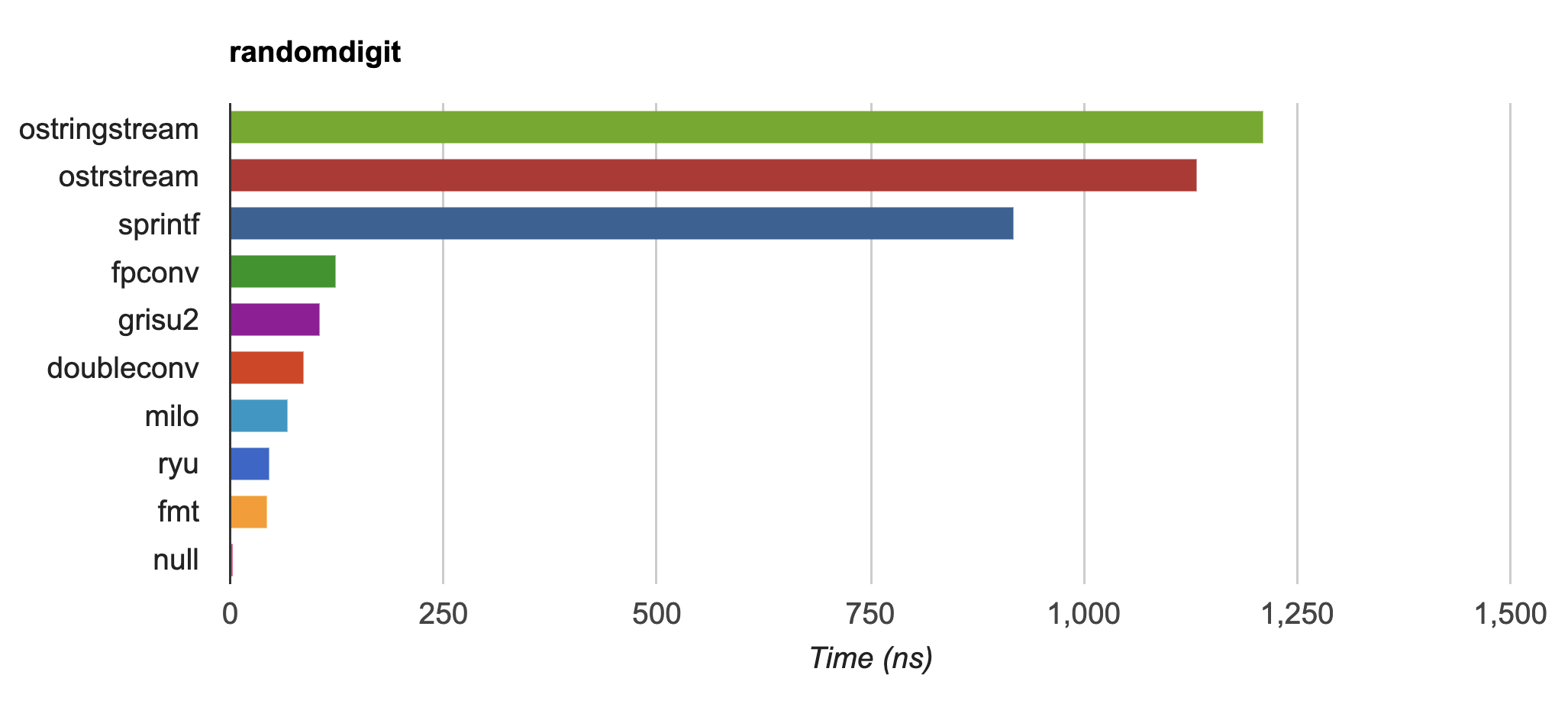
{fmt} is up to 20-30x faster than `std::ostringstream` and `sprintf` on
IEEE754 `float` and `double` formatting
([dtoa-benchmark](https://github.com/fmtlib/dtoa-benchmark)) and faster
than [double-conversion](https://github.com/google/double-conversion)
and [ryu](https://github.com/ulfjack/ryu):
[](https://fmt.dev/unknown_mac64_clang12.0.html)
## Compile time and code bloat
The script [bloat-test.py][test] from [format-benchmark][bench] tests compile
time and code bloat for nontrivial projects. It generates 100 translation units
and uses `printf()` or its alternative five times in each to simulate a
medium-sized project. The resulting executable size and compile time (Apple
clang version 15.0.0 (clang-1500.1.0.2.5), macOS Sonoma, best of three) is shown
in the following tables.
[test]: https://github.com/fmtlib/format-benchmark/blob/master/bloat-test.py
[bench]: https://github.com/fmtlib/format-benchmark
**Optimized build (-O3)**
| Method | Compile Time, s | Executable size, KiB | Stripped size, KiB |
|-----------------|-----------------|----------------------|--------------------|
| printf | 1.6 | 54 | 50 |
| IOStreams | 28.4 | 98 | 84 |
| {fmt} `1122268` | 5.0 | 54 | 50 |
| tinyformat | 32.6 | 164 | 136 |
| Boost Format | 55.0 | 530 | 317 |
{fmt} is fast to compile and is comparable to `printf` in terms of per-call
binary size (within a rounding error on this system).
**Non-optimized build**
| Method | Compile Time, s | Executable size, KiB | Stripped size, KiB |
|-----------------|-----------------|----------------------|--------------------|
| printf | 1.4 | 54 | 50 |
| IOStreams | 27.0 | 88 | 68 |
| {fmt} `1122268` | 4.7 | 87 | 84 |
| tinyformat | 28.1 | 185 | 145 |
| Boost Format | 38.9 | 678 | 381 |
`libc`, `lib(std)c++`, and `libfmt` are all linked as shared libraries
to compare formatting function overhead only. Boost Format is a
header-only library so it doesn\'t provide any linkage options.
## Running the tests
Please refer to [Building the
library](https://fmt.dev/latest/get-started/#building-from-source) for
instructions on how to build the library and run the unit tests.
Benchmarks reside in a separate repository,
[format-benchmarks](https://github.com/fmtlib/format-benchmark), so to
run the benchmarks you first need to clone this repository and generate
Makefiles with CMake:
$ git clone --recursive https://github.com/fmtlib/format-benchmark.git
$ cd format-benchmark
$ cmake .
Then you can run the speed test:
$ make speed-test
or the bloat test:
$ make bloat-test
# Migrating code
[clang-tidy](https://clang.llvm.org/extra/clang-tidy/) v18 provides the
[modernize-use-std-print](https://clang.llvm.org/extra/clang-tidy/checks/modernize/use-std-print.html)
check that is capable of converting occurrences of `printf` and
`fprintf` to `fmt::print` if configured to do so. (By default it
converts to `std::print`.)
# Notable projects using this library
- [0 A.D.](https://play0ad.com/): a free, open-source, cross-platform
real-time strategy game
- [AMPL/MP](https://github.com/ampl/mp): an open-source library for
mathematical programming
- [Apple's FoundationDB](https://github.com/apple/foundationdb): an open-source,
distributed, transactional key-value store
- [Aseprite](https://github.com/aseprite/aseprite): animated sprite
editor & pixel art tool
- [AvioBook](https://www.aviobook.aero/en): a comprehensive aircraft
operations suite
- [Blizzard Battle.net](https://battle.net/): an online gaming
platform
- [Celestia](https://celestia.space/): real-time 3D visualization of
space
- [Ceph](https://ceph.com/): a scalable distributed storage system
- [ccache](https://ccache.dev/): a compiler cache
- [ClickHouse](https://github.com/ClickHouse/ClickHouse): an
analytical database management system
- [ContextVision](https://www.contextvision.com/): medical imaging software
- [Contour](https://github.com/contour-terminal/contour/): a modern
terminal emulator
- [CUAUV](https://cuauv.org/): Cornell University\'s autonomous
underwater vehicle
- [Drake](https://drake.mit.edu/): a planning, control, and analysis
toolbox for nonlinear dynamical systems (MIT)
- [Envoy](https://github.com/envoyproxy/envoy): C++ L7 proxy and
communication bus (Lyft)
- [FiveM](https://fivem.net/): a modification framework for GTA V
- [fmtlog](https://github.com/MengRao/fmtlog): a performant
fmtlib-style logging library with latency in nanoseconds
- [Folly](https://github.com/facebook/folly): Facebook open-source
library
- [GemRB](https://gemrb.org/): a portable open-source implementation
of Bioware's Infinity Engine
- [Grand Mountain
Adventure](https://store.steampowered.com/app/1247360/Grand_Mountain_Adventure/):
a beautiful open-world ski & snowboarding game
- [HarpyWar/pvpgn](https://github.com/pvpgn/pvpgn-server): Player vs
Player Gaming Network with tweaks
- [KBEngine](https://github.com/kbengine/kbengine): an open-source
MMOG server engine
- [Keypirinha](https://keypirinha.com/): a semantic launcher for
Windows
- [Kodi](https://kodi.tv/) (formerly xbmc): home theater software
- [Knuth](https://kth.cash/): high-performance Bitcoin full-node
- [libunicode](https://github.com/contour-terminal/libunicode/): a
modern C++17 Unicode library
- [MariaDB](https://mariadb.org/): relational database management
system
- [Microsoft Verona](https://github.com/microsoft/verona): research
programming language for concurrent ownership
- [MongoDB](https://mongodb.com/): distributed document database
- [MongoDB Smasher](https://github.com/duckie/mongo_smasher): a small
tool to generate randomized datasets
- [OpenSpace](https://openspaceproject.com/): an open-source
astrovisualization framework
- [PenUltima Online (POL)](https://www.polserver.com/): an MMO server,
compatible with most Ultima Online clients
- [PyTorch](https://github.com/pytorch/pytorch): an open-source
machine learning library
- [quasardb](https://www.quasardb.net/): a distributed,
high-performance, associative database
- [Quill](https://github.com/odygrd/quill): asynchronous low-latency
logging library
- [QKW](https://github.com/ravijanjam/qkw): generalizing aliasing to
simplify navigation, and execute complex multi-line terminal
command sequences
- [redis-cerberus](https://github.com/HunanTV/redis-cerberus): a Redis
cluster proxy
- [redpanda](https://vectorized.io/redpanda): a 10x faster Kafka®
replacement for mission-critical systems written in C++
- [rpclib](http://rpclib.net/): a modern C++ msgpack-RPC server and
client library
- [Salesforce Analytics
Cloud](https://www.salesforce.com/analytics-cloud/overview/):
business intelligence software
- [Scylla](https://www.scylladb.com/): a Cassandra-compatible NoSQL
data store that can handle 1 million transactions per second on a
single server
- [Seastar](http://www.seastar-project.org/): an advanced, open-source
C++ framework for high-performance server applications on modern
hardware
- [spdlog](https://github.com/gabime/spdlog): super fast C++ logging
library
- [Stellar](https://www.stellar.org/): financial platform
- [Touch Surgery](https://www.touchsurgery.com/): surgery simulator
- [TrinityCore](https://github.com/TrinityCore/TrinityCore):
open-source MMORPG framework
- [🐙 userver framework](https://userver.tech/): open-source
asynchronous framework with a rich set of abstractions and database
drivers
- [Windows Terminal](https://github.com/microsoft/terminal): the new
Windows terminal
[More\...](https://github.com/search?q=fmtlib&type=Code)
If you are aware of other projects using this library, please let me
know by [email](mailto:victor.zverovich@gmail.com) or by submitting an
[issue](https://github.com/fmtlib/fmt/issues).
# Maintainers
The {fmt} library is maintained by Victor Zverovich
([vitaut](https://github.com/vitaut)) with contributions from many other
people. See
[Contributors](https://github.com/fmtlib/fmt/graphs/contributors) and
[Releases](https://github.com/fmtlib/fmt/releases) for some of the
names. Let us know if your contribution is not listed or mentioned
incorrectly and we\'ll make it right.
[](
https://github.com/fmtlib/fmt/actions?query=workflow%3Alinux)
[](
https://github.com/fmtlib/fmt/actions?query=workflow%3Amacos)
[](
https://github.com/fmtlib/fmt/actions?query=workflow%3Awindows)
[](
https://issues.oss-fuzz.com/issues?q=title:fmt%20cc:victor.zverovich@gmail.com)
[](
https://www.bestpractices.dev/projects/8880)
[](
https://securityscorecards.dev/viewer/?uri=github.com/fmtlib/fmt)
[](https://stackoverflow.com/questions/tagged/fmt)
[](https://novaukraine.org/)
**{fmt}** is an open-source formatting library providing a fast and safe
alternative to C stdio and C++ iostreams.
[Documentation](https://fmt.dev)
[Cheat Sheets](https://hackingcpp.com/cpp/libs/fmt.html)
Q&A: ask questions on [StackOverflow with the tag
fmt](https://stackoverflow.com/questions/tagged/fmt).
Try {fmt} in [Compiler Explorer](https://godbolt.org/z/8Mx1EW73v).
# Features
- Simple [format API](https://fmt.dev/latest/api/) with positional
arguments for localization
- Implementation of [C++20
std::format](https://en.cppreference.com/w/cpp/utility/format) and
[C++23 std::print](https://en.cppreference.com/w/cpp/io/print)
- [Format string syntax](https://fmt.dev/latest/syntax/) similar
to Python\'s
[format](https://docs.python.org/3/library/stdtypes.html#str.format)
- Fast IEEE 754 floating-point formatter with correct rounding,
shortness and round-trip guarantees using the
[Dragonbox](https://github.com/jk-jeon/dragonbox) algorithm
- Portable Unicode support
- Safe [printf
implementation](https://fmt.dev/latest/api/#printf-api)
including the POSIX extension for positional arguments
- Extensibility: [support for user-defined
types](https://fmt.dev/latest/api/#formatting-user-defined-types)
- High performance: faster than common standard library
implementations of `(s)printf`, iostreams, `to_string` and
`to_chars`, see [Speed tests](#speed-tests) and [Converting a
hundred million integers to strings per
second](http://www.zverovich.net/2020/06/13/fast-int-to-string-revisited.html)
- Small code size both in terms of source code with the minimum
configuration consisting of just three files, `base.h`, `format.h`
and `format-inl.h`, and compiled code; see [Compile time and code
bloat](#compile-time-and-code-bloat)
- Reliability: the library has an extensive set of
[tests](https://github.com/fmtlib/fmt/tree/master/test) and is
[continuously fuzzed](https://bugs.chromium.org/p/oss-fuzz/issues/list?colspec=ID%20Type%20Component%20Status%20Proj%20Reported%20Owner%20Summary&q=proj%3Dfmt&can=1)
- Safety: the library is fully type-safe, errors in format strings can
be reported at compile time, automatic memory management prevents
buffer overflow errors
- Ease of use: small self-contained code base, no external
dependencies, permissive MIT
[license](https://github.com/fmtlib/fmt/blob/master/LICENSE)
- [Portability](https://fmt.dev/latest/#portability) with
consistent output across platforms and support for older compilers
- Clean warning-free codebase even on high warning levels such as
`-Wall -Wextra -pedantic`
- Locale independence by default
- Optional header-only configuration enabled with the
`FMT_HEADER_ONLY` macro
See the [documentation](https://fmt.dev) for more details.
# Examples
**Print to stdout** ([run](https://godbolt.org/z/Tevcjh))
``` c++
#include
int main() {
fmt::print("Hello, world!\n");
}
```
**Format a string** ([run](https://godbolt.org/z/oK8h33))
``` c++
std::string s = fmt::format("The answer is {}.", 42);
// s == "The answer is 42."
```
**Format a string using positional arguments**
([run](https://godbolt.org/z/Yn7Txe))
``` c++
std::string s = fmt::format("I'd rather be {1} than {0}.", "right", "happy");
// s == "I'd rather be happy than right."
```
**Print dates and times** ([run](https://godbolt.org/z/c31ExdY3W))
``` c++
#include
int main() {
auto now = std::chrono::system_clock::now();
fmt::print("Date and time: {}\n", now);
fmt::print("Time: {:%H:%M}\n", now);
}
```
Output:
Date and time: 2023-12-26 19:10:31.557195597
Time: 19:10
**Print a container** ([run](https://godbolt.org/z/MxM1YqjE7))
``` c++
#include
#include
int main() {
std::vector v = {1, 2, 3};
fmt::print("{}\n", v);
}
```
Output:
[1, 2, 3]
**Check a format string at compile time**
``` c++
std::string s = fmt::format("{:d}", "I am not a number");
```
This gives a compile-time error in C++20 because `d` is an invalid
format specifier for a string.
**Write a file from a single thread**
``` c++
#include
int main() {
auto out = fmt::output_file("guide.txt");
out.print("Don't {}", "Panic");
}
```
This can be [up to 9 times faster than `fprintf`](
http://www.zverovich.net/2020/08/04/optimal-file-buffer-size.html).
**Print with colors and text styles**
``` c++
#include
int main() {
fmt::print(fg(fmt::color::crimson) | fmt::emphasis::bold,
"Hello, {}!\n", "world");
fmt::print(fg(fmt::color::floral_white) | bg(fmt::color::slate_gray) |
fmt::emphasis::underline, "Olá, {}!\n", "Mundo");
fmt::print(fg(fmt::color::steel_blue) | fmt::emphasis::italic,
"你好{}!\n", "世界");
}
```
Output on a modern terminal with Unicode support:

# Benchmarks
## Speed tests
| Library | Method | Run Time, s |
|-------------------|---------------|-------------|
| libc | printf | 0.66 |
| libc++ | std::ostream | 1.63 |
| {fmt} 12.1 | fmt::print | 0.44 |
| Boost Format 1.88 | boost::format | 3.89 |
| Folly Format | folly::format | 1.28 |
{fmt} is the fastest of the benchmarked methods, \~50% faster than
`printf`.
The above results were generated by building `tinyformat_test.cpp` on
macOS 15.6.1 with `clang++ -O3 -DNDEBUG -DSPEED_TEST -DHAVE_FORMAT`, and
taking the best of three runs. In the test, the format string
`"%0.10f:%04d:%+g:%s:%p:%c:%%\n"` or equivalent is filled 2,000,000
times with output sent to `/dev/null`; for further details refer to the
[source](https://github.com/fmtlib/format-benchmark/blob/master/src/tinyformat-test.cc).
{fmt} is up to 20-30x faster than `std::ostringstream` and `sprintf` on
IEEE754 `float` and `double` formatting
([dtoa-benchmark](https://github.com/fmtlib/dtoa-benchmark)) and faster
than [double-conversion](https://github.com/google/double-conversion)
and [ryu](https://github.com/ulfjack/ryu):
[](https://fmt.dev/unknown_mac64_clang12.0.html)
## Compile time and code bloat
The script [bloat-test.py][test] from [format-benchmark][bench] tests compile
time and code bloat for nontrivial projects. It generates 100 translation units
and uses `printf()` or its alternative five times in each to simulate a
medium-sized project. The resulting executable size and compile time (Apple
clang version 15.0.0 (clang-1500.1.0.2.5), macOS Sonoma, best of three) is shown
in the following tables.
[test]: https://github.com/fmtlib/format-benchmark/blob/master/bloat-test.py
[bench]: https://github.com/fmtlib/format-benchmark
**Optimized build (-O3)**
| Method | Compile Time, s | Executable size, KiB | Stripped size, KiB |
|-----------------|-----------------|----------------------|--------------------|
| printf | 1.6 | 54 | 50 |
| IOStreams | 28.4 | 98 | 84 |
| {fmt} `1122268` | 5.0 | 54 | 50 |
| tinyformat | 32.6 | 164 | 136 |
| Boost Format | 55.0 | 530 | 317 |
{fmt} is fast to compile and is comparable to `printf` in terms of per-call
binary size (within a rounding error on this system).
**Non-optimized build**
| Method | Compile Time, s | Executable size, KiB | Stripped size, KiB |
|-----------------|-----------------|----------------------|--------------------|
| printf | 1.4 | 54 | 50 |
| IOStreams | 27.0 | 88 | 68 |
| {fmt} `1122268` | 4.7 | 87 | 84 |
| tinyformat | 28.1 | 185 | 145 |
| Boost Format | 38.9 | 678 | 381 |
`libc`, `lib(std)c++`, and `libfmt` are all linked as shared libraries
to compare formatting function overhead only. Boost Format is a
header-only library so it doesn\'t provide any linkage options.
## Running the tests
Please refer to [Building the
library](https://fmt.dev/latest/get-started/#building-from-source) for
instructions on how to build the library and run the unit tests.
Benchmarks reside in a separate repository,
[format-benchmarks](https://github.com/fmtlib/format-benchmark), so to
run the benchmarks you first need to clone this repository and generate
Makefiles with CMake:
$ git clone --recursive https://github.com/fmtlib/format-benchmark.git
$ cd format-benchmark
$ cmake .
Then you can run the speed test:
$ make speed-test
or the bloat test:
$ make bloat-test
# Migrating code
[clang-tidy](https://clang.llvm.org/extra/clang-tidy/) v18 provides the
[modernize-use-std-print](https://clang.llvm.org/extra/clang-tidy/checks/modernize/use-std-print.html)
check that is capable of converting occurrences of `printf` and
`fprintf` to `fmt::print` if configured to do so. (By default it
converts to `std::print`.)
# Notable projects using this library
- [0 A.D.](https://play0ad.com/): a free, open-source, cross-platform
real-time strategy game
- [AMPL/MP](https://github.com/ampl/mp): an open-source library for
mathematical programming
- [Apple's FoundationDB](https://github.com/apple/foundationdb): an open-source,
distributed, transactional key-value store
- [Aseprite](https://github.com/aseprite/aseprite): animated sprite
editor & pixel art tool
- [AvioBook](https://www.aviobook.aero/en): a comprehensive aircraft
operations suite
- [Blizzard Battle.net](https://battle.net/): an online gaming
platform
- [Celestia](https://celestia.space/): real-time 3D visualization of
space
- [Ceph](https://ceph.com/): a scalable distributed storage system
- [ccache](https://ccache.dev/): a compiler cache
- [ClickHouse](https://github.com/ClickHouse/ClickHouse): an
analytical database management system
- [ContextVision](https://www.contextvision.com/): medical imaging software
- [Contour](https://github.com/contour-terminal/contour/): a modern
terminal emulator
- [CUAUV](https://cuauv.org/): Cornell University\'s autonomous
underwater vehicle
- [Drake](https://drake.mit.edu/): a planning, control, and analysis
toolbox for nonlinear dynamical systems (MIT)
- [Envoy](https://github.com/envoyproxy/envoy): C++ L7 proxy and
communication bus (Lyft)
- [FiveM](https://fivem.net/): a modification framework for GTA V
- [fmtlog](https://github.com/MengRao/fmtlog): a performant
fmtlib-style logging library with latency in nanoseconds
- [Folly](https://github.com/facebook/folly): Facebook open-source
library
- [GemRB](https://gemrb.org/): a portable open-source implementation
of Bioware's Infinity Engine
- [Grand Mountain
Adventure](https://store.steampowered.com/app/1247360/Grand_Mountain_Adventure/):
a beautiful open-world ski & snowboarding game
- [HarpyWar/pvpgn](https://github.com/pvpgn/pvpgn-server): Player vs
Player Gaming Network with tweaks
- [KBEngine](https://github.com/kbengine/kbengine): an open-source
MMOG server engine
- [Keypirinha](https://keypirinha.com/): a semantic launcher for
Windows
- [Kodi](https://kodi.tv/) (formerly xbmc): home theater software
- [Knuth](https://kth.cash/): high-performance Bitcoin full-node
- [libunicode](https://github.com/contour-terminal/libunicode/): a
modern C++17 Unicode library
- [MariaDB](https://mariadb.org/): relational database management
system
- [Microsoft Verona](https://github.com/microsoft/verona): research
programming language for concurrent ownership
- [MongoDB](https://mongodb.com/): distributed document database
- [MongoDB Smasher](https://github.com/duckie/mongo_smasher): a small
tool to generate randomized datasets
- [OpenSpace](https://openspaceproject.com/): an open-source
astrovisualization framework
- [PenUltima Online (POL)](https://www.polserver.com/): an MMO server,
compatible with most Ultima Online clients
- [PyTorch](https://github.com/pytorch/pytorch): an open-source
machine learning library
- [quasardb](https://www.quasardb.net/): a distributed,
high-performance, associative database
- [Quill](https://github.com/odygrd/quill): asynchronous low-latency
logging library
- [QKW](https://github.com/ravijanjam/qkw): generalizing aliasing to
simplify navigation, and execute complex multi-line terminal
command sequences
- [redis-cerberus](https://github.com/HunanTV/redis-cerberus): a Redis
cluster proxy
- [redpanda](https://vectorized.io/redpanda): a 10x faster Kafka®
replacement for mission-critical systems written in C++
- [rpclib](http://rpclib.net/): a modern C++ msgpack-RPC server and
client library
- [Salesforce Analytics
Cloud](https://www.salesforce.com/analytics-cloud/overview/):
business intelligence software
- [Scylla](https://www.scylladb.com/): a Cassandra-compatible NoSQL
data store that can handle 1 million transactions per second on a
single server
- [Seastar](http://www.seastar-project.org/): an advanced, open-source
C++ framework for high-performance server applications on modern
hardware
- [spdlog](https://github.com/gabime/spdlog): super fast C++ logging
library
- [Stellar](https://www.stellar.org/): financial platform
- [Touch Surgery](https://www.touchsurgery.com/): surgery simulator
- [TrinityCore](https://github.com/TrinityCore/TrinityCore):
open-source MMORPG framework
- [🐙 userver framework](https://userver.tech/): open-source
asynchronous framework with a rich set of abstractions and database
drivers
- [Windows Terminal](https://github.com/microsoft/terminal): the new
Windows terminal
[More\...](https://github.com/search?q=fmtlib&type=Code)
If you are aware of other projects using this library, please let me
know by [email](mailto:victor.zverovich@gmail.com) or by submitting an
[issue](https://github.com/fmtlib/fmt/issues).
# Maintainers
The {fmt} library is maintained by Victor Zverovich
([vitaut](https://github.com/vitaut)) with contributions from many other
people. See
[Contributors](https://github.com/fmtlib/fmt/graphs/contributors) and
[Releases](https://github.com/fmtlib/fmt/releases) for some of the
names. Let us know if your contribution is not listed or mentioned
incorrectly and we\'ll make it right.